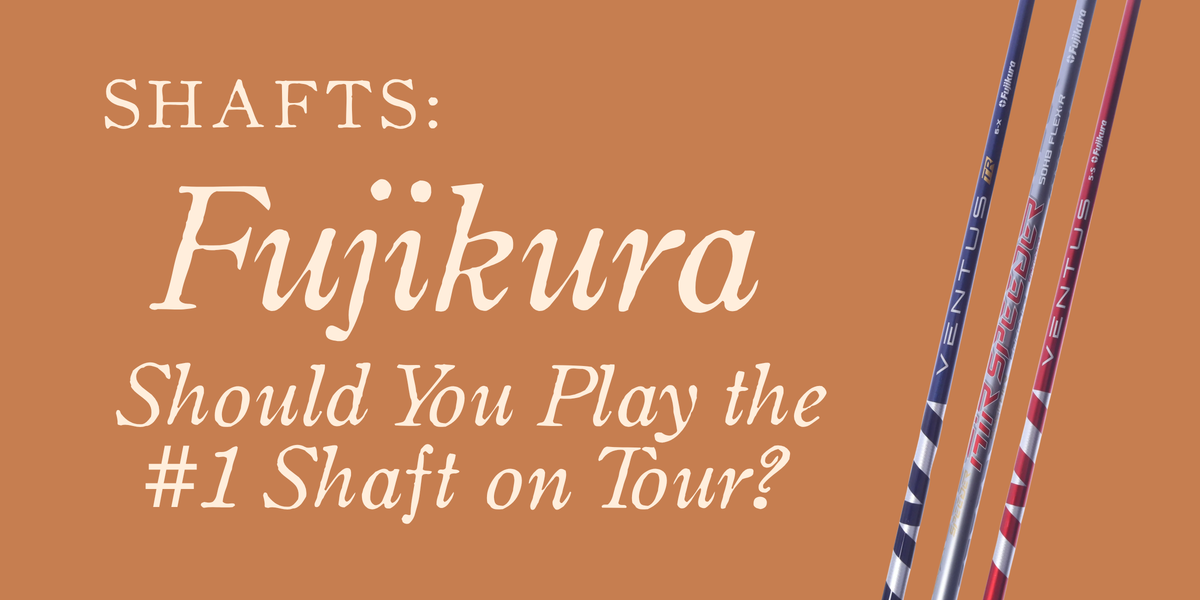

When golfers think about premium graphite golf shafts, Fujikura is one of the first names that comes to mind. The company has built a reputation around stability, consistency, innovative composite construction and an extensive fitting matrix that allows golfers to fine-tune their swing.
Fujikura golf shafts have such a great reputation, in fact, that it’s been the number one driver-shaft brand on the PGA Tour for six consecutive years (according to Darrell Survey data).
But does being the most-used shaft on Tour mean Fujikura golf shafts are automatically the right shaft for your golf game?
Let's take a look at Fujikura's history, its current shaft lineup, the technology behind VENTUS, and what all of that means when you are choosing a shaft for your own game.
Table of Contents
- Fujikura Golf Shafts: A Quick History, and the Tech Behind VENTUS
- The Current Fujikura Shaft Lineup
- What We Have Found in Our Testing
- The Bottom Line
Fujikura Golf Shafts: A Quick History, and the Tech Behind VENTUS
How long has Fujikura been making shafts?
Fujikura golf shafts have been around since 1974, but it was the Speeder 757 that put the brand on the map, becoming the No. 1 driver shaft on the PGA Tour in 2000. That reputation now belongs to VENTUS, which launched on Tour in 2018 and has gone through several evolutions since — currently landing in its VeloCore+ generation.
What is Velocore?
The technology behind that reputation is VeloCore: a multi-material bias-core construction built to keep the shaft stable through the transition and impact, which can lead to more centered strikes and tighter dispersion.
What is VeloCore+?
VeloCore+ (2024) pushed the concept further, adding another premium core material aimed at tighter dispersion and more ball speed. Of course, no shaft technology overcomes a poor fit—a shaft that's the wrong weight, flex or bend profile for your swing will underperform no matter how advanced it is.
What is enso®?
Fujikura also runs its own 3-D motion-capture system, called enso, to study how the shaft and club move throughout the entire swing—not just what the ball does after impact. That research is behind features like Speeder NX's Variable Torque, which treats twisting stiffness as something that varies along the shaft rather than one number for the whole thing.
The Current Fujikura Shaft Lineup
VENTUS gets most of the attention, but it's only one piece of Fujikura's lineup. The company builds shafts across drivers, fairway woods, hybrids, utility irons and traditional irons, each family with its own weight, flex, launch and feel profile, built for a different kind of swing.
Here's a breakdown of each of the Fujikura golf shafts, and which type of golfer it tends to suit best.
Fujikura Golf Shafts
The Current Fujikura Lineup
| Model / Color | Launch | Spin |
|---|---|---|
| VENTUS | ||
| RedIn Stock | High | High |
| BlueIn Stock | Mid | Mid |
| BlackIn Stock | Low | Low |
| VENTUS TR | ||
| TR RedIn Stock | Mid-High | High |
| TR BlueIn Stock | Mid | Low |
| TR BlackIn Stock | Low | Low |
| Speeder NXShop All | ||
| NX Blue | Mid-High | Mid |
| NX Green | Mid | Low-Mid |
| NX Black | High | Low |
| NX Gold / Violet | Ultra-lightweight, built for speed | |
| Air SpeederShop All | ||
| All Models | Ultra-lightweight family for effortless speed | |
| PROShop All | ||
| PRO Blue | Mid-High | Mid |
| PRO Black | Low | Low |
| Vista ProShop All | ||
| All Models | Accessible, easy-to-fit, multiple weights and profiles | |
| Sakura | ||
| All Models | High | High |
Launch and spin are broad design characteristics — actual ball flight depends on your swing, clubhead, loft, weight, and flex. Linked models are in stock and ready to ship.
VENTUS
VENTUS is Fujikura's flagship wood-shaft family, built around the company's stability-focused design philosophy, with the current generation using VeloCore+ technology.
The Lineup…
VENTUS Red
Generally the higher-launching, higher-spin option.
Best for: moderate-to-slower swing speeds, or golfers who need help getting the ball up in the air and carrying it.
VENTUS Blue
Generally the mid-launch, mid-spin option, and the most versatile of the three.
Best for: a wide range of swing speeds and handicaps. It’s the default starting point if you're not sure which way to go.
VENTUS Black
Generally the lower-launching, lower-spin option.
Best for: faster swing speeds and more aggressive transitions. This is for low handicap players who already flight the ball well and don't need help launching it.


VENTUS TR
VENTUS TR takes that same stability-first philosophy and pushes it further. It adds Spread Tow carbon fabric to VeloCore (or VeloCore+ in newer versions), increasing torsional stiffness in the mid/handle section. The result is a family aimed at golfers who want more stability without the entire shaft feeling excessively rigid.
The Lineup…
TR Red
Mid-to-high launch, higher-spin option.
Best for: the golfer above who also needs help launching the ball.
TR Blue
Mid-launch, low-spin option with a stiff tip section and firm handle.
Best for: smooth to moderate tempos looking for a penetrating flight with controlled spin.
TR Black
Lower-launch, lower-spin, with a very stiff handle, mid and tip.
Best for: faster, more aggressive players who don't need launch help.


Speeder NX
Speeder remains an important part of Fujikura's identity, and Speeder NX brings that name into the enso era through Variable Torque — the same twisting-stiffness research mentioned earlier, applied here as a defining feature rather than a background detail. It's a good reminder that Fujikura's lineup isn't a straight line where each new shaft replaces the last; different families are built to produce genuinely different combinations of feel and performance.
The Lineup…
NX Blue: Mid-high launch, mid-spin; smooth feel with tight dispersion.
NX Green: Mid-launch, low-to-mid spin; stiffer mid section for players with faster tempos.
NX Black: High launch, low-spin; firmer tip for explosive speed without ballooning.
NX Gold / Violet: Ultra-lightweight profiles designed to maximize swing speed and launch for lower-to-moderate swing speeds.

Air Speeder
Air Speeder is Fujikura's ultra-lightweight family — straightforward in concept: lighter construction and materials to help generate clubhead speed while retaining a usable level of stability and feel.
Best for: golfers looking to add speed with less physical effort. Check these out if you’re a slower-swing-speed player, senior, or someone who simply performs better with lighter overall club weight.

PRO
Fujikura's PRO Series brings premium materials, lower resin content, accelerated taper designs and different bend profiles into a family built to give fitters another set of tools — which matters because there's no single "Fujikura swing." Two golfers can post identical clubhead speeds and still need very different shafts, depending on how they load it, how quickly they transition, and where they release the club.
The Lineup…
PRO Blue: Mid-to-high launch, mid-spin profile designed for feel and stability.
PRO Black: Lower-launch, low-spin alternative with a stiffer tip for aggressive swing speeds.

Vista Pro
Vista Pro is a more accessible, easy-to-fit family with multiple weights and profiles — a reflection of Fujikura's broader strategy of not just building Tour shafts and expecting recreational golfers to make them work, but fitting a genuinely wide range of golfers and swing types.
Best for: golfers newer to premium aftermarket shafts, or anyone who wants a wide-net starting point before narrowing in on something more specialized.

Sakura
Sakura is built around lightweight construction and a smoother feel, with a softer mid and tip section designed to increase launch and spin.
Best for: golfers who struggle to get the ball airborne or generate carry. Check out this model if you’re a slower-swing-speed or senior golfer who wants an easier launch without moving into a heavier, stiffer shaft.
What We Have Found in Our Testing
After years of testing Fujikura golf shafts, one word consistently comes to mind:
Consistency.
That doesn't mean every Fujikura shaft produces the same ball flight. Quite the opposite. The different Fujikura families and profiles can produce very different launch, spin and feel characteristics.
The consistency is in the way the shafts tend to deliver the performance they were designed to provide.
A well-fitted Fujikura shaft can give a golfer a repeatable feel, predictable launch conditions and confidence that the shaft is doing something consistent from swing to swing.
That characteristic helps explain why Fujikura has become so prominent on professional Tours. Fujikura's Tour success is not based on one shaft. It is the result of a large product ecosystem, extensive engineering research, professional feedback and a fitting philosophy that extends from Tour players to everyday golfers.
The Bottom Line
So, is the #1 shaft brand on Tour the shaft you should play?
The answer depends on your swing.
The more important takeaway is that Fujikura offers enough profiles that there's a good chance one of them fits your game.
Go with VENTUS Black if you're already flying it well and just need more stability, VENTUS Red or Sakura if you need help getting the ball airborne, TR if your misses scatter left and right, or Air Speeder if you need more speed with less effort.
Don't buy a shaft just because a Tour player uses it — buy the one that matches your swing.