
Your swing speed is a useful starting point for choosing shaft flex. But buying the right shaft takes a little more than matching a number to a letter.
This golf shaft flex chart will help you narrow your options, whether you’re replacing a driver shaft or shopping for irons. We’ll also cover what to do between two flexes, how your 5-iron distance can help, and why your driver and irons don’t have to use the same flex.
The goal is to find a shaft you can swing comfortably and hit consistently. There’s no advantage in playing something stiffer (or softer) than you need.
Table of Contents
- Golf Shaft Flex Chart by Driver Swing Speed
- What If You're Between Two Flexes?
- Does Flex Change Between Driver and Irons?
- Common Shaft Flex Mistakes
- Browse Golf Shafts by Flex
Golf Shaft Flex Chart by Driver Swing Speed
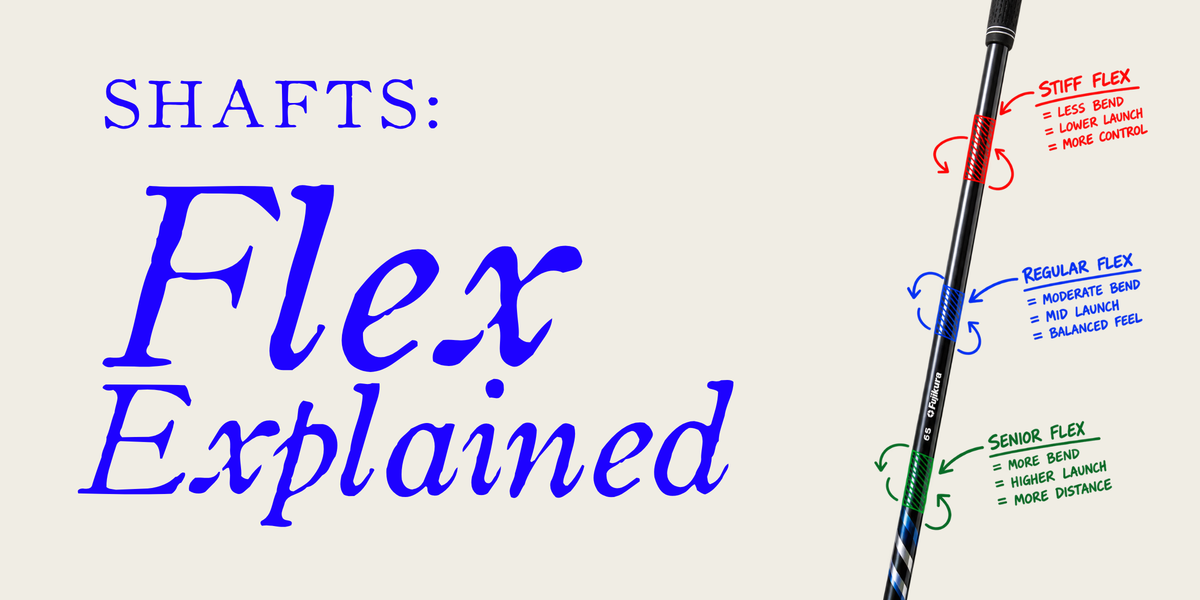
Shaft flex describes how much a shaft resists bending under load. You’ll usually see it expressed as a category, such as Regular or Stiff, rather than a measurement.
Start with your normal driver clubhead speed, measured in miles per hour. Not ball speed…club speed.
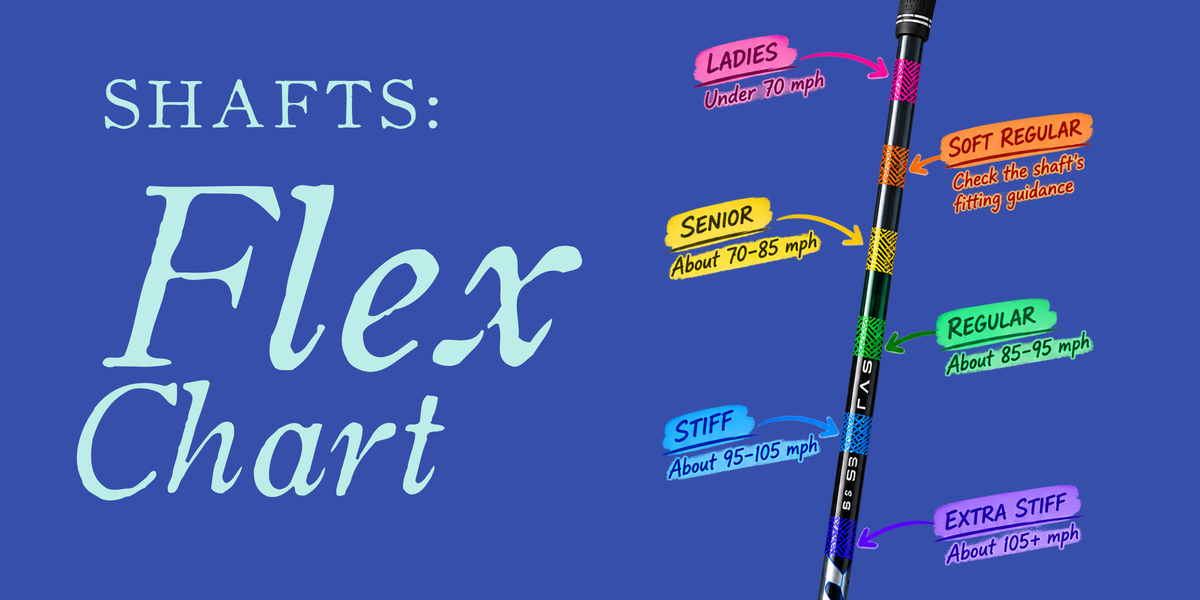
Golf Shaft Flex Chart
Flex by Driver Swing Speed
| Shaft Flex | Driver Swing Speed | How to Use It |
|---|---|---|
| Ladies | Under 70 mph | Start by testing more flexible options. |
| Soft Regular | Check the shaft's fitting guidance | This label doesn't have a consistent, separate speed range across brands. |
| Senior | About 70–85 mph | Compare suitable Senior options with neighboring flexes if you're near a boundary. |
| Regular | About 85–95 mph | A starting point for moderate driver speeds. |
| Stiff | About 95–105 mph | Compare Stiff models suited to your speed and swing. |
| Extra Stiff | About 105+ mph | Worth testing at higher speeds, particularly alongside Stiff near the boundary. |
| Tour Extra Stiff | Model-specific; fitting recommended | Don't assume crossing 105 mph automatically means you need TX. |
The five numerical ranges follow Next Round's shaft buying guide. Read the boundaries as areas of overlap, not hard cutoffs — a golfer at 95 mph should test both Regular and Stiff.
The five numerical ranges follow Next Round’s shaft buying guide. Soft Regular and Tour Extra Stiff are included as shopping categories, but assigning each a universal speed band would suggest more precision than the labels provide.
Read the boundaries as areas of overlap. A golfer swinging at 95 mph should consider testing Regular and Stiff rather than treating that number as an automatic instruction to switch.
Why other golf shaft flex charts give different answers
There is no universal standard for shaft flex. A Stiff shaft in one model can feel and perform differently from a Stiff shaft in another.
Published speed recommendations vary, too. PGA TOUR Superstore’s chart puts Stiff at 95–110 mph and Extra Stiff above 110 mph. That doesn’t make the golf shaft flex chart above useless. It means a general chart helps you choose what to test.
Once you’re considering a particular shaft, check the manufacturer’s guidance for that model and weight.
Can you choose shaft flex from 5-iron carry?
Your 5-iron carry can provide a rough reference if you don’t know your swing speed. Carry means the distance the ball travels before landing, without the roll afterward.
For example, GolfWorks estimates that a golfer who hits a 5-iron 150 yards may have a driver swing speed around 70–79 mph. Treat that as a rough estimate, especially if your iron contact is inconsistent.
Model-specific charts can offer more detail. SMT’s KBS Tour 105 listing gives these references:
KBS Tour 105
Flex by 5-Iron Carry
| KBS Tour 105 Flex | Published 5-Iron Carry |
|---|---|
| Regular | 165–185 yards |
| Stiff | 185–205 yards |
Specific to this shaft listing — not a universal chart for every iron shaft.
Those recommendations apply to that shaft listing. They shouldn’t become a universal chart for every iron shaft.
Your 5-iron’s loft, strike quality, and playing conditions all affect distance. Two golfers carrying different 5-irons the same distance won’t necessarily need the same flex.
Use your typical carry from several solid shots on level ground. If that estimate and your measured driver speed suggest different flexes, test the clubs separately.
How to get your swing speed
A fitting facility or golf shop with a suitable launch monitor can measure your driver clubhead speed. Confirm that clubhead speed is included before booking.
Warm up, then hit several drives with your normal swing. Use the speed you can repeat on the course rather than the fastest swing you can produce in the bay.
If most swings fall between 92 and 95 mph, that range tells you more than the one swing that reaches 100.
What If You're Between Two Flexes?
If your speed falls near a boundary, test both flexes. Neither “always go softer” nor “always go stiffer” works for everyone.
How you apply force during the swing matters alongside your final clubhead speed. GolfWorks includes tempo and release in its shaft-selection process for that reason.
A forceful change of direction from backswing to downswing may make a firmer shaft worth trying. A smoother transition may suit a softer option. Those are reasons to include a shaft in the test, not enough information to declare a winner.
For a useful comparison, keep the clubhead, loft setting, playing length, and ball the same where possible. Start with neighboring flexes in the same shaft model and similar weights.
Otherwise, you might prefer the second club because it’s shorter or lighter, then mistakenly credit the flex.
Compare these results:
Testing Two Flexes
Compare These Results
Carry Distance
How far do your normal shots fly?
Dispersion
How widely do shots finish left, right, short, and long?
Contact
Which setup helps you find the center of the face?
Flight
Does the ball reach a useful height?
Feel
Can you make your usual swing without forcing it?
Judge the whole group of shots. One unusually long drive shouldn’t outweigh repeated misses.
For example, suppose one shaft produces your longest shot but also several wide misses. Another carries a few yards shorter and keeps more shots near your target. The second may be the better choice for your game.
Bring your current club to the comparison, too. A new shaft should offer a useful improvement over what you already own.
Does Flex Change Between Driver and Irons?
Yes. You can play different flexes in your driver and irons (and even fairway woods).
A driver shaft and an iron shaft are different designs built for different clubs. Matching the flex doesn’t guarantee matching feel, and using different letters doesn’t mean your set is poorly fitted.
You might prefer stiff in your driver and Regular in your irons, or find that another combination performs better. Test each club for the job it needs to do.
With a driver, you’re looking for useful distance and a manageable shot pattern. With irons, pay close attention to repeatable carry distances and whether the ball flies high enough to stop on the green.
Some iron-shaft manufacturers do publish recommendations based on driver speed. For example, UST Mamiya’s Recoil DART ESX guide recommends overlapping driver-speed ranges for its iron flexes: 80–95 mph for Regular and 90–105 mph for Stiff.
That overlap is useful. It shows why two golfers with similar speeds can reasonably test different flexes within the same product family.
If you’re replacing iron shafts, evaluate them in the heads you intend to play whenever possible. The complete club needs to work for you.
Common Shaft Flex Mistakes
Choosing by age or gender
“Ladies” and “Senior” are product labels. They don’t tell you who is allowed to use them.
A younger golfer with a slower swing may suit Senior flex. An older golfer with a faster swing may suit Stiff. Choose according to your swing and results.
Assuming stiffer means better
A stiffer shaft is better if it performs better for you. Duh. But, think about it. That shaft’s job is to help you put your ball on target as often as possible. The end.
Be it stiff, regular, x stiff, whatever.
If you hit your current shaft consistently, a golf shaft flex chart alone isn’t a reason to replace it. If you’re testing alternatives, let repeatable performance decide.
Expecting flex to fix a slice
A slice doesn’t prove your shaft is too stiff, and a hook doesn’t prove it’s too soft.
Shaft changes can affect how you deliver the club, but those shot patterns also have other causes. Have your contact and swing checked before buying a replacement based solely on the direction of your misses.
Fujikura cautions that a shaft’s advertised launch, spin, and profile characteristics don’t produce identical results for every golfer.
Ignoring shaft weight
Flex is only one specification. Weight can change how a club feels throughout the swing, even when the flex label stays the same.
When comparing shafts, write down the model, weight, flex, and playing length. “I liked the Stiff one” isn’t enough information to find that same setup later.
Assuming Soft Regular labels always match
Check the manufacturer’s terminology before ordering. Don’t assume abbreviations such as SR or R2 mean precisely the same thing across brands.
If a listing is unclear, ask for the complete model name and flex marking. That’s especially useful when shopping pre-owned shafts.
Buying a used shaft without checking the build
The correct model and flex still need to fit your club.
For a driver shaft, confirm adapter compatibility and expected playing length in your head. Ask whether the shaft has been tip-trimmed, since that can affect how it plays.
For irons, check tip size and whether the shaft is intended for the club you’re reshafting. Have a club builder confirm any specification you can’t establish from the listing.
Quick Recap
Common Shaft Flex Mistakes
- Choosing by age or gender labels instead of your own swing
- Assuming stiffer automatically means better
- Expecting flex alone to fix a slice or hook
- Ignoring shaft weight when comparing flexes
- Assuming Soft Regular (SR/R2) labels match across brands
- Buying a used shaft without checking adapter, tip, and build
Browse Golf Shafts by Flex
Once you’ve narrowed your options from the golf shaft flex chart, browse the relevant flex categories at Next Round Golf. Compare the full specifications with the shaft you tested or the recommendation from your fitter.
Golf Shaft Flex Chart
Browse Golf Shafts by Flex
Use your swing speed to narrow the search, then choose the shaft that gives you the most dependable results with your normal swing.