You’re building your first golf bag. You’ve snagged a driver, a few irons, and a putter you feel confident sinking a few putts with. But then you hit the wedge aisle, and see gap, sand, lob, and pitching wedge options staring back at you. As a beginner, do you really need all four?
Eventually, yes. Carrying four wedges is what the pros do, and for good reason. Evenly spaced wedges let you use the same swing to cover a much wider range of approach distances, and they give you more options for tricky lies around the green.
So where do you start? With the pitching wedge. Its loft usually comes from your iron set, so most players use it as the baseline for spacing out their other wedges.
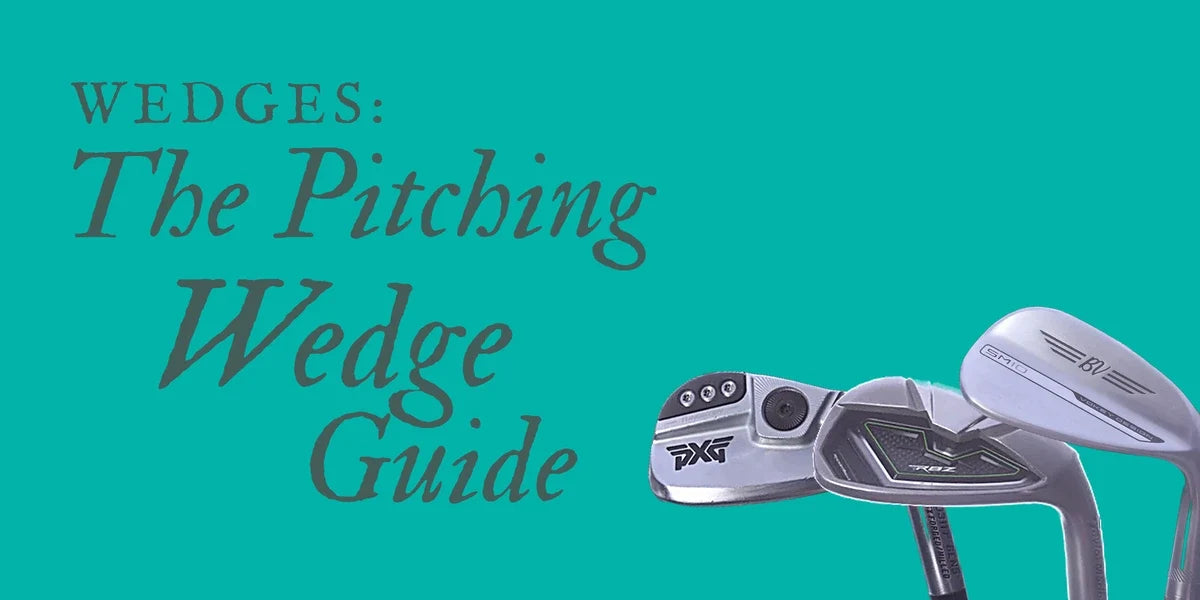
In this pitching wedge guide, we’ll walk through what a pitching wedge actually is, the numbers behind it, how far you can expect to hit it, and how to use it to build your wedge setup. We’ll also share a few of our favorite pitching wedges to add to your bag.
Table of Contents
What is a pitching wedge?
In the bag, a pitching wedge sits right between your 9-iron and your gap wedge. Think of it as the bridge between your irons and your "scoring wedges," e.g. the highest-lofted clubs in your bag.
With 44 to 48 degrees of loft, a pitching wedge can do a little bit of everything. You can take a full swing for a high approach shot into the green, or choke down for a low bump-and-run for shots when you’re just off the green. The range between full shots and short strategic ones is exactly why this is one wedge that you must carry. It’s also the reason you’ll find it (and likely a sand wedge) in most iron or full-bag sets.
What loft is a pitching wedge?
Most pitching wedges have between 44 and 48 degrees of loft. The exact pitching wedge degree depends on what kind of set it came from…
| Set type | Typical pitching wedge loft | What it’s built for |
|---|---|---|
| Game-improvement (modern standard) | 44° – 45° | The most common range today. Balances extra distance with decent height and stopping power. |
| Players / tour irons | 46° – 48° | Traditional loft focused on trajectory control, spin, and precise distance gapping. |
| Specialty / blade wedges | 46° – 48° | Sold individually (like the Titleist Vokey or Cleveland RTX) to replace a set’s pitching wedge for better feel and spin. |
Why pitching wedge lofts keep getting lower
If you’re comparing an older set to a newer one, you’ll probably notice the pitching wedge loft has dropped over the years. Why? Manufacturers have gradually strengthened lofts across the whole iron set so every club flies farther. But, with distance comes launch trade-offs; a 44° pitching wedge launches lower and spins less than a 48° one.
The lower loft matters for two reasons. First, on your approach shots you want a mid-to-high launch so the ball comes in steep and stops quickly on the green. Too little loft and the ball keeps rolling; too much and you start losing distance and control. Second, it affects your gapping. If your pitching wedge is 44° and your sand wedge is 56°, that’s a 12-degree gap, which can leave you with an awkward "in-between" yardage.
When should you use a pitching wedge?
So when do you reach for your pitching wedge instead of your 9-iron or one of your higher-lofted wedges? Here are the three situations where the pitching wedge should make an appearance…
A full approach shot into the green
You can consider the full approach shot the pitching wedge’s main job. Depending on your handicap, if you’re anywhere between 90-125 yards out from the green, this is the club that’ll get you there.
- When the yardage fits. On par 4s and par 5s, pull it when your remaining distance matches your full-swing pitching wedge distance (see below for average distance by handicap).
- When you need the ball to stop. A pitching wedge generates more backspin and a steeper landing angle than a 9-iron, so it’s ideal when you need the ball to land on the green and stay there.
- On short par 3s. Teeing the ball up slightly higher and using your pitching wedge can give you clean contact, maximum accuracy, and a great on-the-green tee shot.
Around the green (bump-and-run chips)
When you’re chipping around the green, the pitching wedge can be a great tool in your short game arsenal. Use it when…
- There’s lots of green to work with. If you’re just off the green and have plenty of flat turf between your ball and the hole, a pitching wedge is a safe and predictable option for your chip. It’ll pop the ball just over the fringe and start rolling towards the hole like a putt.
- You’re on tight or bare lies. Since the pitching wedge has a sharper leading edge and lower bounce than a sand wedge, it slides cleanly under the ball on dirt and short fairway grass without bouncing into the middle of the ball.
Specialty and recovery shots
- Punching out from under trees. If your ball ends up under a thicket of trees, a pitching wedge can clear obstacles or thick rough while keeping the ball low.
- Fairway bunkers with low lips. If you find a fairway bunker 100+ yards from the green with a low front lip, a pitching wedge helps you pick the ball cleanly off the sand and still reach the green.
How far should you hit a pitching wedge?
Your pitching wedge distance depends on swing speed, strike quality, and the loft of your specific club. That said, here’s a general idea of average pitching wedge distances by skill level:
| Skill level | Typical handicap | Average pitching wedge distance |
|---|---|---|
| Low handicap | 0 – 5 | 125 – 141 yards |
| Mid handicap | 10 – 15 | 115 – 121 yards |
| High handicap | 20 – 25+ | 90 – 108 yards |
What matters most is knowing your number. Next time you’re at the range or hitting on the sim, hit 10 full pitching wedge shots, toss out the longest and shortest, and average the rest. That’s your stock yardage. Knowing this number across all the clubs in your bag will make picking the right one a lot easier.
Our favorite pitching wedges
Whether you’re replacing the pitching wedge that came with your set or upgrading to something with more feel, here are a few of our go-to picks.


The bottom line
When it comes to the wedges you’ll carry, start with your pitching wedge. With 44 to 48 degrees of loft, this versatile club can handle everything from full approach shots to those under the trees recovery shots. And once you know your distance and have a solid model in your hands, you’ll have a reliable go-to club every time you’re inside 140 yards.
Ready to add one to your bag? Shop pre-owned pitching wedges at Next Round Golf and get tour-quality clubs for a lot less than new.
Pitching wedge FAQs
What degree is a pitching wedge?
A standard pitching wedge is between 44 and 48 degrees. Most modern game-improvement sets land around 44° to 45°, while players’ irons and specialty wedges tend to sit at 46° to 48°.
Is a pitching wedge good for chipping?
Yes. A pitching wedge is one of the best clubs for bump-and-run chips, especially when you have a lot of green between you and the hole. It gets the ball rolling quickly, which is easier to control than a high, spinning chip with a lob wedge.
Do I need a gap wedge if I have a pitching wedge?
It depends on your lofts. If there’s more than about 6 degrees between your pitching wedge and your sand wedge, a gap wedge helps fill the distance in between. With a 44° pitching wedge and a 56° sand wedge, it’s well worth adding one.