Golf is a challenging sport even without having challenging clubs. Long irons (2-irons through 4-irons) are generally considered the hardest clubs to hit well. If reaching for these leaves you feeling a bit uneasy, you’re not alone.
That’s where hybrids come in. A cross between a fairway wood and an iron, they’re an easier to hit club to gain the height and distance that you might struggle to achieve with irons.
If you’re considering adding hybrids to your beginner bag, this is the guide for you. We’re walking through each hybrid, how to choose between hybrids and irons, use cases, and our favorite models.
Table of Contents
What is a hybrid golf club?
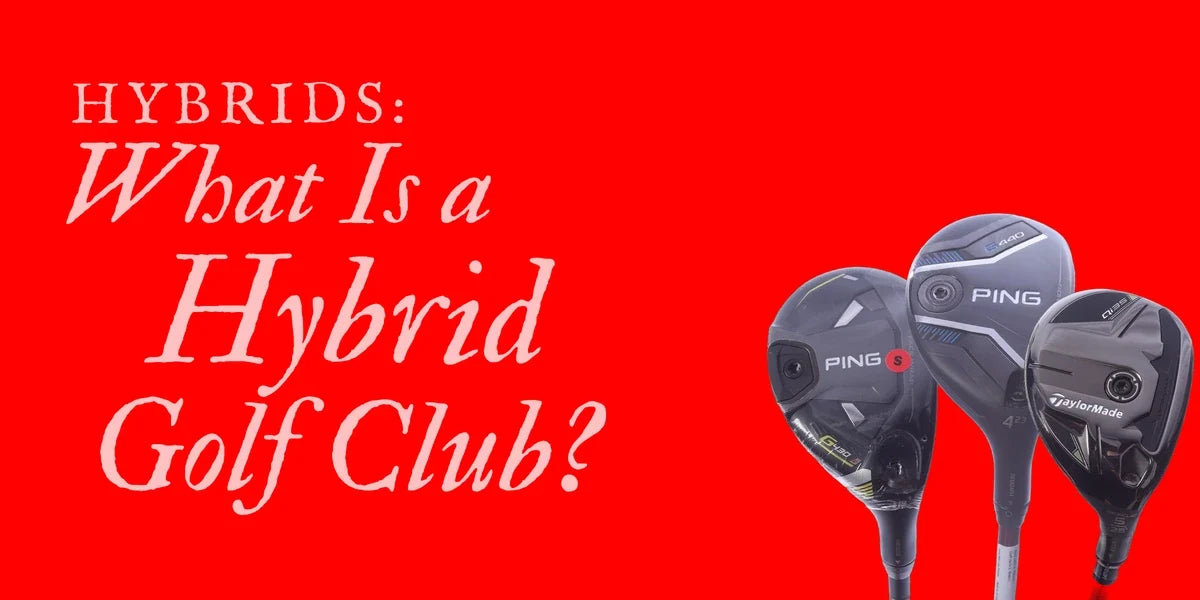
A hybrid golf club is exactly what it sounds like: it’s the best of both worlds of a fairway wood and iron. It borrows the rounded, forgiving sole and extra distance of a fairway wood and marries it with the compact shape, accuracy, and control of a long iron.
A hybrid is a lot easier to get in the air than your classic long iron, but it’s still easy to aim and control. Sometimes, hybrids are referred to as “rescue clubs,” because they help bail you out of tricky shots that would be difficult to get right with an iron.
Hybrids are numbered just like irons, usually from a 2-hybrid up to a 7-hybrid. Their loft ranges from about 16 degrees on a 2-hybrid to around 34 degrees on a 7-hybrid.
What do hybrid golf clubs replace?
Here’s a quick cheat sheet for which hybrid can replace which club…
| Hybrid | Typical loft | Replaces | Best for |
|---|---|---|---|
| 2-hybrid (2H) | 16° – 18° | 2-iron or 5-wood | Tee shots and long approach shots on par 5s |
| 3-hybrid (3H) | 19° – 21° | 3-iron or 7-wood | The most common hybrid. Great for long approaches and thick rough. |
| 4-hybrid (4H) | 22° – 24° | 3-iron or 4-iron | The easiest starting point for mid-to-high handicappers |
| 5-hybrid (5H) | 25° – 27° | 4-iron or 5-iron | High approach shots that land softly on the green |
| 6- and 7-hybrid (6H/7H) | 28° – 34° | 6-iron or 7-iron | The easiest launch for slower swing speeds and seniors |
These are your options when it comes to hybrids, but you don’t need them all. You can start by replacing the longest iron in your bag that you don’t feel comfortable hitting, like a 4 or 5-iron.
Hybrid vs. iron: which one should you use?
When it comes to choosing a hybrid over an iron (or vice versa), it’s a judgment call. Here are a few things to consider…
| Hybrid | Long iron (3, 4, or 5-iron) | |
|---|---|---|
| Ball flight | Launches higher, comes down steeper, and stops faster on the green | Lower, more penetrating flight with more roll after it lands |
| Forgiveness | Bigger sweet spot, so off-center hits still go pretty far | Smaller sweet spot, so mishits lose a lot of distance |
| Turf interaction | Wide, rounded sole glides through thick rough | Thin, sharp sole can dig into soft ground or get caught in rough |
| Shot shaping | Built to go high and straight, so it’s harder to curve on purpose | Easier to hit a draw or fade and control your trajectory |
| Best swing speed | Moderate to slower | Faster |
When should you use a hybrid?
Hybrids are way more versatile than most people expect. Here are four spots where they really earn their keep in your bag.
Getting out of thick rough
Sharp edges can get twisted or caught in thick rough. With the wide, rounded sole of a hybrid, you’ll slide right through the grass and get back onto the fairway.
Long approach shots into greens
When you’re hitting onto the green and want it to stop fast, a hybrid is a solid club pick. Since the weight sits lower in the clubhead, it’ll launch the ball higher. When the ball comes down at a steeper angle, it’s more likely to stop where you want it.
Tight or intimidating tee shots
You can think of your hybrid as a “fairway finder.” Let’s say you’re on a narrow par 4, or your 3-wood just hasn’t been performing the way it should. A 2- or 3-hybrid has a shorter shaft and more loft than a driver or 3-wood, making it easier to keep in the fairway and gain distance.
Tricky or uneven lies
A tricky shot needs a reliable club. When the ball is above or below your feet, in a shallow fairway bunker, or on a patchy lie, you can trust a hybrid. It has a bigger sweet spot and curved sole, making it a more forgiving club, even when conditions aren’t perfect.
How far should you hit your hybrids?
Your hybrid distance depends on your swing speed and striking, but here’s generally what you can expect, hybrid by hybrid.
| Hybrid | Low handicap (~5) | Mid handicap (~15) | High handicap (~25) |
|---|---|---|---|
| 2-hybrid (16° – 18°) | 189 / 215 yds | 163 / 204 yds | 134 / 168 yds |
| 3-hybrid (19° – 21°) | 181 / 207 yds | 166 / 195 yds | 132 / 161 yds |
| 4-hybrid (22° – 24°) | 174 / 199 yds | 155 / 188 yds | 121 / 149 yds |
| 5-hybrid (25° – 27°) | 162 / 184 yds | 143 / 175 yds | 113 / 140 yds |
Our favorite hybrids
If we were re-building our bags, these are the hybrids we would reach for.


The bottom line
If long irons have been a stressful part of your golf game, consider making the switch to hybrids. Hybrids launch higher, forgive more mishits, and handle everything from thick rough to tight tee shots. Start by replacing the long iron you trust the least, learn your hybrid distances, and you’ll have a go-to club for all those in-between shots.
Ready to try one? Shop pre-owned hybrids at Next Round Golf and get a game-changing club for a lot less than new.
Hybrid golf club FAQs
What is a hybrid golf club used for?
A hybrid is mainly used to replace long irons. It’s great for long approach shots, getting out of the rough, tee shots on tight holes, and tricky lies where an iron is hard to hit cleanly.
Are hybrids easier to hit than irons?
For most golfers, yes. Hybrids have a bigger sweet spot, a wider sole, and weight positioned low in the clubhead, which makes it easier to get the ball in the air and keep it straight. That’s especially true compared to 3-, 4-, and 5-irons.
What iron does a 4-hybrid replace?
A 4-hybrid usually replaces a 3-iron or 4-iron. It typically has 22 to 24 degrees of loft.