
Stiff sounds better than Regular. Tour Extra Stiff sounds better still.
But the shaft’s job is to help you hit good golf shots. Playing a stiffer flex doesn’t earn you anything if you can’t hit it consistently.
Choosing the right golf shaft flex starts with your swing speed. From there, you need to consider how you swing, how the club feels, and what happens when you hit the ball.
This guide explains what flex actually does, which category to start with, and how to tell whether a change is worth making. You’ll also learn why your driver and irons don’t necessarily need the same flex.
The recommendation is straightforward: use your speed to choose what to test, then let your normal shots decide.
Table of Contents
- What Golf Shaft Flex Actually Does
- How to Find Your Golf Shaft Flex
- Signs You're in the Wrong Golf Shaft Flex
- Does Flex Matter More in Drivers or Irons?
- Browse Golf Shafts by Flex
What Golf Shaft Flex Actually Does
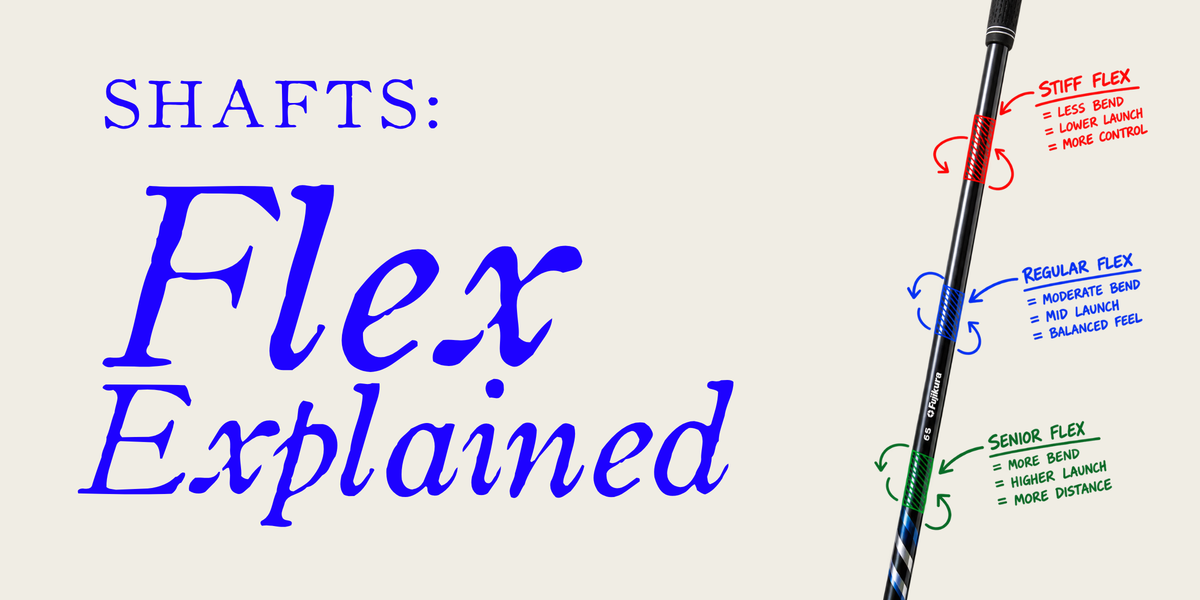
A golf shaft bends during the swing. Flex describes its resistance to that bending.
A softer shaft bends more under the same load. A stiffer shaft resists bending more. Neither is automatically better.
The shaft’s movement can influence how you deliver the clubhead to the ball. It also affects what you feel through your hands, which may influence how you swing.
How flex can affect ball flight
The loft presented at impact helps determine how the ball launches. That’s called dynamic loft, and it isn’t necessarily the loft stamped on your club.
Trackman identifies shaft bending as one of several factors affecting dynamic loft, alongside your release, attack angle, face orientation, and strike location.
That’s why changing shafts can change your flight. It’s also why “softer launches higher” and “stiffer launches lower” aren’t reliable promises for every golfer.
You may deliver one shaft differently from another. A shaft that helps one player flight the ball lower may do little for someone else.
How flex affects feel
You might describe a shaft as firm, smooth, loose, or difficult to feel during the swing. Those impressions are useful when comparing clubs.
But feel needs to agree with performance.
A shaft can feel great and still spray the ball all over the park. Another can feel unfamiliar initially and give you more consistent contact. Give yourself enough swings to judge both.
Fujikura recommends evaluating shafts with a fitter because their advertised launch, spin, and bend characteristics don’t translate into the same results for every player.
What the flex rating doesn’t tell you
It doesn’t explain the stiffness of every section of the shaft.
Two stiff shafts can have different weights and different stiffness patterns from grip to tip. They may feel quite different in your hands.
Wishon’s shaft-fitting resources use measured bend profiles to compare shaft stiffness more accurately than labels alone allow.
So, if you like a particular stiff shaft, write down the model and weight. Buying another shaft with an S on it won’t necessarily reproduce that feel.
How to Find Your Golf Shaft Flex
Start with a measured swing speed if you can. Carry distance is a useful secondary clue, but it leaves more room for guesswork.
Measure your normal driver swing speed
There’s generally a Dick’s, PGA Tour Superstore, some other big box golf store, or even your local golf shop, that should have a top flight launch monitor so you can get your swing speed measured.
Club speed. Not ball speed.
Warm up, then hit a group of drives using the swing you would take onto the course. Don’t try to set a personal record.
If you repeatedly swing between 88 and 92 mph, use that range when choosing shafts to test. You need to get fitted for your average swing speed, not your best swing.
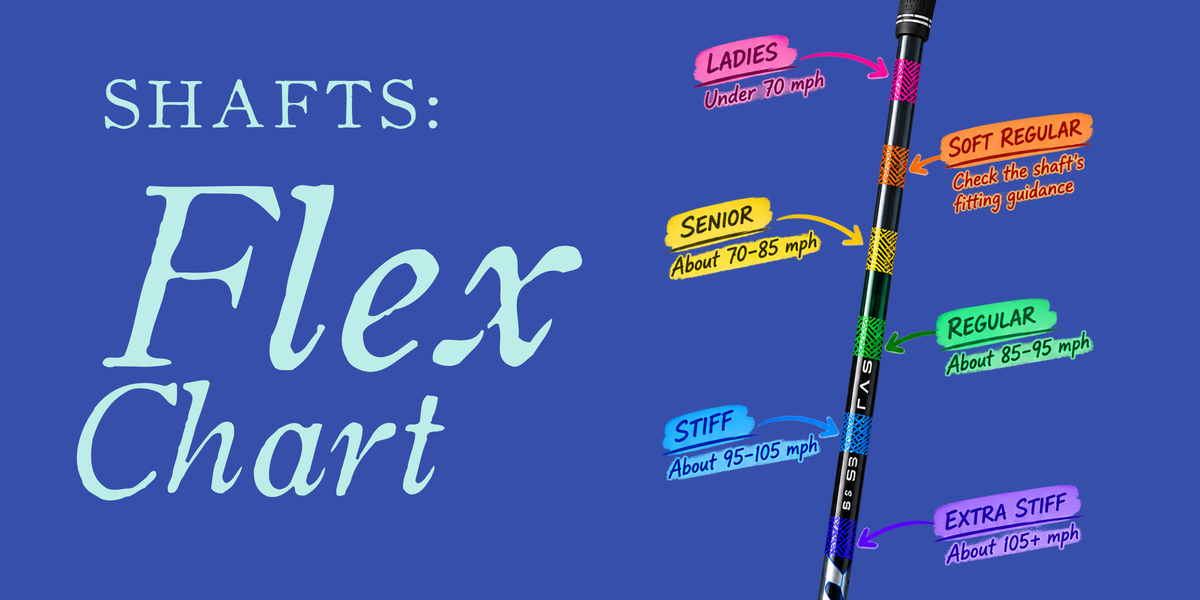
Golf shaft flex chart: where to start
The numerical ranges below follow Next Round’s shaft buying guide. They are starting points for testing, with overlap around the boundaries.
Golf Shaft Flex Chart
Where to Start
| Shaft Flex | Driver Swing Speed Reference | What to Do Next |
|---|---|---|
| Ladies | Under 70 mph | Start with more flexible options suited to your speed. |
| Soft Regular | Model-specific | Check the manufacturer’s guidance rather than assigning it a universal speed band. |
| Senior | About 70–85 mph | Test suitable Senior shafts and neighboring flexes near the boundaries. |
| Regular | About 85–95 mph | Begin with Regular and compare alternatives if the results suggest a poor fit. |
| Stiff | About 95–105 mph | Start with Stiff, considering your transition and the specific shaft. |
| Extra Stiff | About 105+ mph | Compare X with suitable Stiff options around the lower end. |
| Tour Extra Stiff | Model-specific | Choose through testing rather than a speed threshold alone. |
As I said before, none of the above is gospel, but the information is a solid place to begin.
Published charts also differ. PGA TOUR Superstore places Stiff at 95–110 mph and Extra Stiff above 110 mph. That’s a good reason to check the recommendations for the shaft you’re actually considering.
For more detail on the categories and boundaries, see our golf shaft flex chart.
Use carry distance when you don’t know your speed
Carry is how far the ball flies before it lands. Total distance includes the roll, which varies widely based on many, many factors and is thus, unreliable.
Use carry when consulting a fitting chart that asks for it. A drive that lands at 210 yards and rolls to 240 is a 210-yard carry.
Manufacturer recommendations can help you interpret that number. For example, UST Mamiya’s Recoil DART ESX guide lists these driver carry references for its iron-shaft flexes:
Recoil DART ESX
Driver Carry Reference
| Recoil DART ESX Flex | Driver Carry Reference |
|---|---|
| Ladies / F1 | 150–190 yards |
| Senior / F2 | 175–215 yards |
| Regular / F3 | 200–240 yards |
| Stiff / F4 | 225–265 yards |
Notice the overlap. These are recommendations for that product family, not a universal distance chart.
Your 5-iron can offer another clue. GolfWorks gives a rough example of a 150-yard 5-iron corresponding to approximately 70–79 mph of driver swing speed.
That estimate becomes less useful if you struggle to strike your 5-iron consistently. Loft, wind, elevation, and contact also affect distance.
Use several representative shots in ordinary conditions. Not downwind or into the wind. And, not uphill or downhill.
Consider how you change direction
Two golfers can reach the same clubhead speed with different swings.
I’m a tempo guy with a smooth transition. I get my speed from proper sequence and a pinch of athletic ability.
One of my buddies was a D1 college athlete. A wide receiver and a state record holder in the hundred yard dash.
He’s got more fast twitch muscle fibers than the next 10 guys I know. He whips the club back and down like he’s pulling his hand off a hot stove.
We drive it about the same distance, but in VERY different ways.
Wishon’s fitting approach considers transition force, downswing tempo, and release when selecting a shaft.
A forceful transition gives you a reason to test a firmer option. A smooth transition gives you a reason to include a softer one. Neither settles the choice before you hit them.
Test the likely flex against one alternative
Bring your current club so you have something familiar to compare.
Where possible, use the same head, loft setting, playing length, and ball while comparing neighboring flexes in the same shaft model. Keep weights similar, too.
Then look at:
Test the Likely Flex Against One Alternative
Then Look At
Contact
Which option helps you strike the face more consistently?
Carry
Which produces useful distance on ordinary swings?
Dispersion
How widely do the shots finish around your target?
Flight
Is the height suitable for the club?
Comfort
Can you swing normally without forcing it?
Take breaks before fatigue changes your swing. If the results are close, return to your current club and compare again.
You don’t have to buy something just because you booked a fitting.
Signs You're in the Wrong Golf Shaft Flex
The strongest evidence is a repeatable improvement when you test another shaft. A single bad shot proves very little.
Still, certain patterns make a comparison worthwhile.
The club feels difficult to swing naturally
Pay attention if you feel you must swing unusually hard to make the club work, or slow down deliberately to keep it under control.
That doesn’t establish whether the shaft is too stiff or too soft. Weight, length, and balance may also contribute.
Tell the fitter what you’re doing to compensate. “I feel like I have to rush from the top” is more useful than “I think I need Regular.”
Your flight is consistently too low or too high
Low shots with disappointing carry can justify testing a softer shaft. A flight that climbs excessively and loses useful distance can justify testing a firmer option.
PGA TOUR Superstore lists low flight and reduced distance among possible signs of excessive stiffness, while associating overly flexible shafts with ballooning and inconsistent control.
Treat those as clues. Loft and strike location need checking as well.
A low drive struck near the bottom of the face isn’t enough evidence to order a softer shaft.
Your misses are difficult to predict
If you’re missing both directions and can’t produce a dependable shot pattern, a shaft comparison may help identify a more suitable setup.
Trackman explains that face-to-path influences ball curvature. A shaft change may affect your delivery, but it doesn’t replace understanding what the clubface is doing.
Have someone assess the swing and equipment together.
Another shaft performs better across several shots
Suppose your current setup produces a few good drives mixed with several large misses. A different shaft gives you similar carry with a tighter group.
That’s a useful result.
Now suppose the replacement produces one longer drive, but the rest look much like your current club. That’s less convincing.
Keep the ordinary misses in the comparison. You’re buying a club to use on the course, where those shots count.
If the alternative differs in weight or length, recognize that you’re evaluating the complete setup. The improvement may involve more than flex.
Signs You're in the Wrong Golf Shaft Flex
- The club feels difficult to swing naturally
- Your flight is consistently too low or too high
- Your misses are difficult to predict
- Another shaft performs better across several shots
Does Flex Matter More in Drivers or Irons?
It matters in both, but the problems you’re trying to solve differ.
You will seldom, if ever, try to hit your driver a certain distance. (You may have a minimum carry number.) That’s pretty much all you’re trying (or should be trying) to do with your irons.
Start with whichever part of your bag is causing the bigger problem.
What to prioritize in your driver
You want adequate distance for your swing speed and you want playable shots into the green. Compare carry, strike location, and the width of your shot pattern.
Ask whether you can make your normal swing and produce a result you’d accept on the course.
What to prioritize in your irons
With irons, compare distance consistency as well as average distance and accuracy.
Imagine two 7-iron setups. One produces carries of 150, 152, and 151 yards on representative strikes. The other produces 145, 158, and 150.
Those hypothetical results would make the first setup easier to choose a target with, even though the second produced the longest shot.
Check the longer irons, too. A shaft that feels comfortable in a short iron still needs to work in the clubs you find harder to launch.
Your flexes don’t have to match
You can play Stiff in your driver and Regular in your irons, or another combination. Fairway woods and hybrids can have their own requirements.
I play a stiff shaft in my driver and irons, but I sometimes prefer x-stiff in fairway woods and hybrid.
Fit each club for its intended use rather than making the labels match.
A driver shaft and an iron shaft differ in design, length, and weight. Their flex letters don’t make them directly interchangeable.
If one part of your bag works, keep that information. You may only need to change the club that’s causing trouble.
Browse Golf Shafts by Flex
Start with the category closest to your normal driver speed. If you’re near a boundary, compare the neighboring flex. Then check the specific model’s recommendations and test before committing when possible.
Already hitting your current shaft well? Keep playing it. The chart isn’t a reason to replace equipment that works.
Once you know what you need, browse these Next Round Golf categories:
These are affiliate links. Golfer Geeks may earn a commission if you buy through them, at no additional cost to you.
Golf Shaft Flex Explained
Browse Golf Shafts by Flex
Before ordering, confirm the model, weight, flex, length, and compatibility with your clubhead. For a pre-owned shaft, ask about any previous tip trimming.
Buy the setup that helps you put the ball on target more often. Whatever letter is printed on it.